
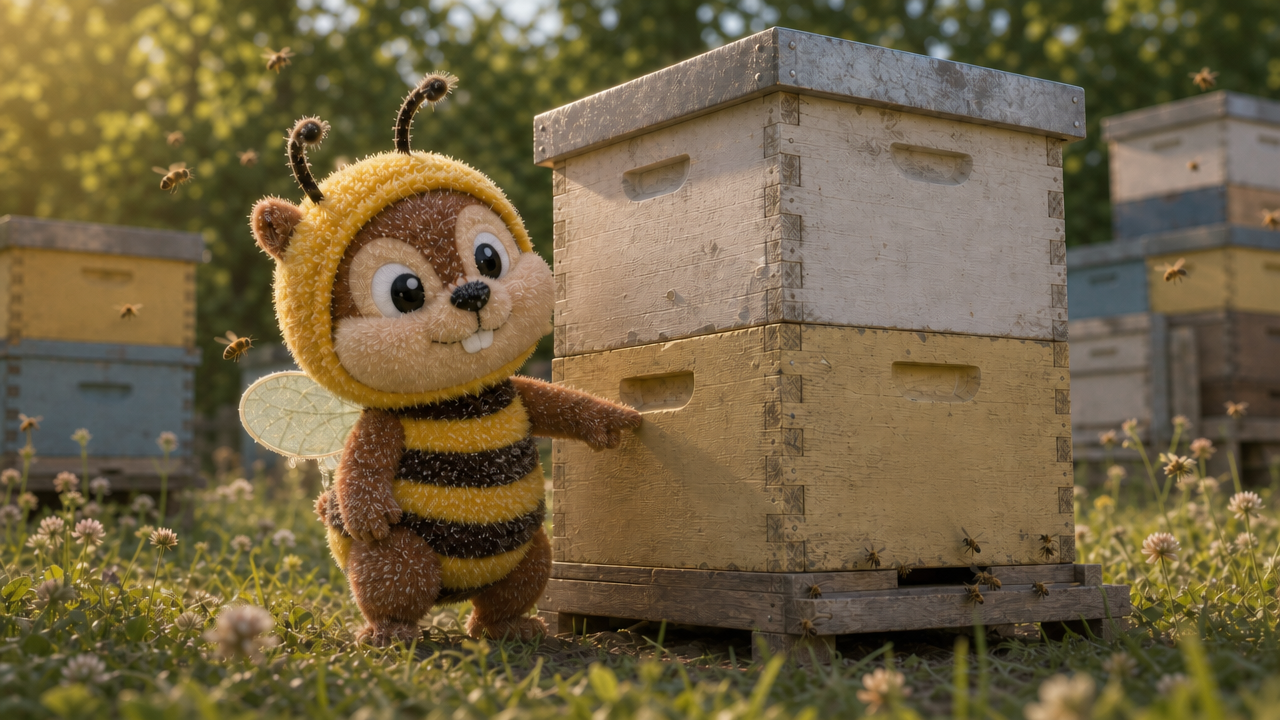
A brood box is the part of a beehive where the queen spends most of her time laying eggs and the colony raises its young. There is nothing inherently different about the box itself. It is a standard Langstroth box, designated the "brood box" by the beekeeper because of how the colony uses it: as the queen's quarters, where eggs, larvae, pupae, and most of the nurse bees are concentrated, along with stored pollen, nectar, and honey the bees keep close to the developing brood.
Bees are naturally inclined to position the brood nest low in the cavity with honey stores above it, so the brood box is usually the lowest box on the hive. That is not always the case. Coming out of winter, for example, the cluster may have moved up through the honey stores and the brood nest may no longer be in the bottommost box.
What does the brood box do?
The honey bee brood box contains the biological heart of the colony. It is the centralized area where the next generation of bees are raised, and it drives much of the colony's behavior. In beekeeping, the brood box serves several interconnected functions:
Reproductive center. The primary purpose of the brood nest is to provide a controlled environment for the queen to lay eggs and for larvae and pupae to develop. The queen moves across combs in the brood box, laying eggs in cells that workers have cleaned and prepared. Those eggs hatch into larvae, which are fed by nurse bees, then capped and allowed to pupate. About 21 days after the egg was laid (for workers), a new bee emerges. The brood nest is strategically organized, usually in a spherical or elliptical shape across several frames, to maximize the efficiency of the queen's laying pattern.
Nutrient processing and distribution. The brood nest is surrounded by a pollen mantle and honey stores. This proximity matters because nurse bees need immediate access to protein (pollen) and carbohydrates (honey and nectar) to produce jelly, which are essential for feeding the developing larvae. The bees keep these resources close for a reason: every extra inch between the nurse and her food supply is time and energy the colony cannot afford during peak brood rearing.
Communication hub. The brood nest is the primary site for pheromonal communication in the colony. Brood pheromone, produced by the developing larvae, signals to the rest of the colony that reproduction is active and the queen is productive. These chemical signals influence worker behavior in concrete ways: they stimulate foragers to collect more pollen, inhibit the development of worker ovaries, and help regulate the ratio of nurse bees to foragers. When brood pheromone drops (because brood rearing slows or stops), the colony's behavior shifts accordingly.
Structural organization. A healthy brood nest follows a consistent layout across the frames in the brood box:
- Center: eggs and young larvae
- Outer ring: capped brood (pupae)
- Immediate perimeter: a halo of bee bread (fermented pollen)
- Corners and top edges: capped honey for insulation and quick-access energy
Illustration placeholder: brood nest diagram showing the dome of capped brood, pollen ring, and nectar/honey ring across multiple frames.
This pattern is consistent enough that beekeepers use it to read colony health during inspections. A tight, organized brood pattern with pollen and nectar around the edges usually signals a queenright colony with adequate forage.
Where does the brood box sit in the hive?
In a standard Langstroth setup, the beehive brood box sits low in the stack; immediately above your bottom board. A typical hive configuration, from top to bottom might look like this:
If you use a queen excluder, the brood is confined to the box or boxes below it. The queen cannot pass through the excluder, so all egg laying happens below that barrier. The worker bees can still move freely through it to store honey above, but the queen stays in the brood chamber.
Developing brood is sensitive to temperature. The colony maintains the brood area between 32 °C and 35 °C, generating heat by vibrating their flight muscles and cooling through water evaporation and fanning. This constraint is one reason the bees keep the brood nest compact and centrally located within the box, rather than spread across the entire hive.
Not all beekeepers use queen excluders. In operations without one, the queen may occasionally wander up into the lower supers and lay a few frames of brood there. This is not ideal for honey production, but it is not a disaster either. Some beekeepers call queen excluders "honey excluders" because they believe workers are reluctant to pass through them, though that view is not universally held.
Brood box sizes
A beekeeping brood box is standard Langstroth equipment. What makes it a brood box for bees is the colony's use of it, not its dimensions. The two most common box depths used as brood boxes are:
| Box depth | Depth (inches) | Typical use |
|---|---|---|
| Deep | (9⅝") | Standard brood box in most North American operations |
| Medium | (6⅝") | Used as brood box in all-medium operations; also standard honey super size |
The image below shows 10-frame Deep and Medium box dimensions.
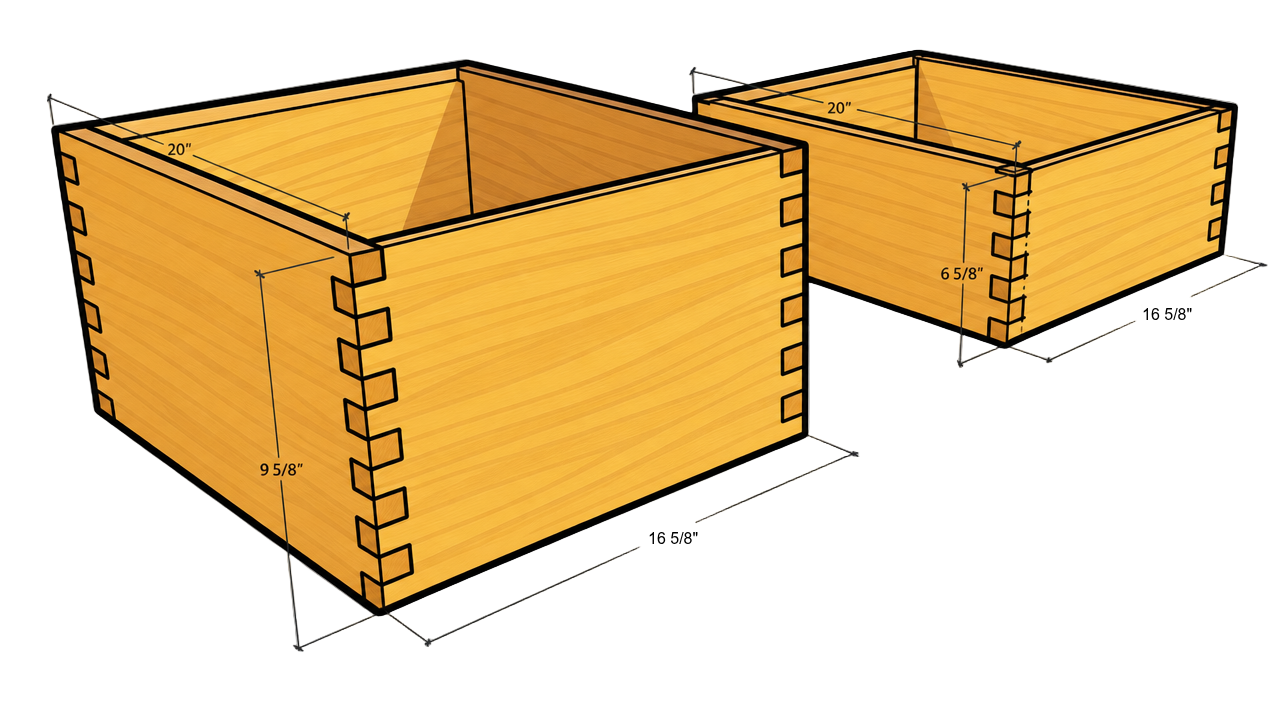
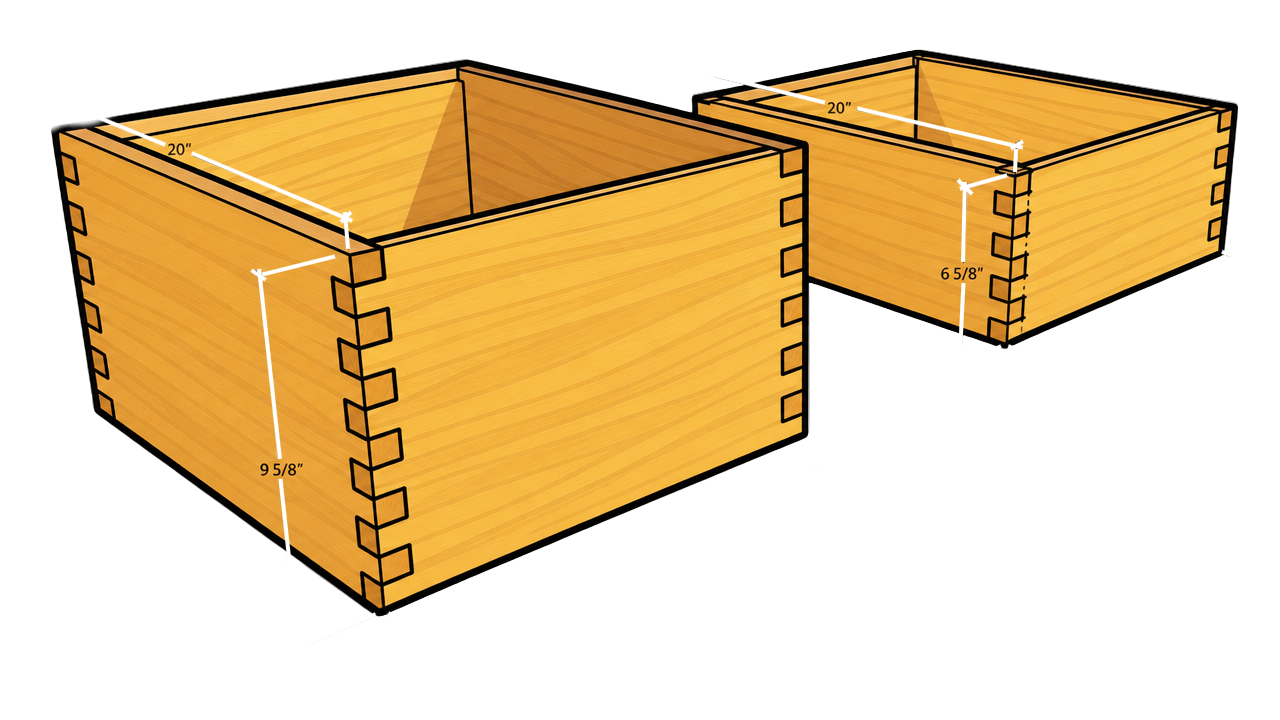
Frame count (8 or 10 frame) changes only the width of the box, not the depth of the frames. A deep box holds the same frames whether it is 8-frame or 10-frame equipment.
The important thing is consistency within your own operation. Mixing deeps and mediums as brood boxes in the same hive works, but the frames are not interchangeable between the two depths. The same principle applies to 8-frame and 10-frame equipment—while you can run either size successfully, the boxes themselves are not interchangeable between the two widths, so you'll want to commit to one format to avoid ending up with a mismatched assortment of gear that won't stack or swap cleanly.
How many brood boxes per hive?
The number of brood boxes is mainly a question of space margin: how much room the colony needs for brood, adult bees, pollen, nectar, winter stores, and empty comb ahead of the queen.
On paper, a single deep looks like enough. A productive queen laying 2,000 eggs per day produces about 42,000 occupied worker-brood cells over the 21-day worker development cycle, and a 10-frame deep holds roughly 64,000 to 70,000 cells. The brood math fits.
But a brood box is more than just brood. The same box has to hold pollen, nectar, honey, drone brood, open laying space, and room for bees to move and process incoming nectar. The brood nest itself is not spread evenly across all 10 frames — bees keep the main brood area in the center, with pollen around it and honey or nectar toward the top, corners, and outer frames. A single deep can hold a peak brood cohort for a short window, but it leaves no margin. Once nectar starts packing into the brood nest, the queen loses open cells, nurse bees feel crowded, and the swarm impulse can build before the box is literally full.
A second brood box solves this by giving the colony an "upstairs" for extra brood, food, adult bees, and open comb. In the coldest climates, it also becomes the winter pantry — a colony may need up to 65 kg of winter stores, and a single deep cannot comfortably hold that much food alongside the bees and brood.
That gives four common configurations:
| Configuration | What it is | Best suited for |
|---|---|---|
| Single deep | One deep brood box with supers added promptly above | Experienced beekeepers practicing active, hands-on management |
| Double deep | Two deep brood boxes | New beekeepers, strong colonies, cold winters, and forgiving management |
| Triple medium | Three medium brood boxes | All-medium operations; similar working volume to two deeps with lighter boxes |
| Deep + medium | One deep plus one medium | A middle ground for more space than a single deep without the weight of two |
As a rule of thumb, start with the colony's needs — bees, brood, food, empty comb — then adjust for your winter. If your bees must carry months of food in the hive, two deeps or the equivalent are safer. If you run a single deep, treat it as an active management system, not a set-it-and-forget-it setup. Our Winter Feeding Guide covers this in detail.
When to add a second brood box
Add a second brood box before the colony becomes crowded, not after every cell is full. Knowing when to add another brood box comes down to reading the bees, not the calendar.
The easiest rule is this: add the next brood box when the bees are actively using about 70–80% of the current brood box. In a 10-frame deep, that usually means about 7 or 8 frames are drawn and covered with bees. In an 8-frame deep, it usually means about 6 frames are drawn and covered.
Look for several signs together, not just one:
- Most of the frames are drawn or being drawn quickly.
- Bees are covering most of the frames, not just the middle cluster.
- The queen is laying across several frames.
- You see eggs, larvae, and capped brood in an expanding pattern.
- Fresh nectar and pollen are coming in.
- The brood nest still has some open cells, but it is clearly tightening up.
- You are starting to see nectar or pollen stored inside the brood area instead of around it.
That last point matters. When nectar starts appearing in cells where the queen should be laying, the brood nest is being backfilled. The colony may still look strong and healthy, but the queen is losing room. This is one of the practical warning signs that the hive needs more space.
Do not add it too early
A small colony does not benefit from a large empty hive. If only 3 or 4 frames are covered with bees, adding another box usually gives them more space than they can heat, guard, or patrol. That can slow buildup, especially in cool spring weather.
Wait until the colony is clearly expanding. If the bees are still clustered tightly in the middle, keep them in one box, feed if appropriate, and check again soon.
Do not wait too long
Waiting too long is usually the bigger mistake. During spring buildup, a strong colony can change quickly. A hive that looked comfortable one week can be crowded the next, especially when brood is emerging and nectar is coming in.
During swarm season, inspect strong colonies every 7–10 days. If the brood box is nearly full of bees, brood, pollen, and nectar, you are not “saving space” by waiting. You are letting the colony get closer to swarming.
How to add the second brood box
Place the second brood box directly above the first brood box. Do not put a queen excluder between brood boxes; the queen needs access to the full brood chamber.
If you have drawn comb, use it. Drawn comb is immediately useful to the queen and workers. If you only have foundation, add the box when the colony is strong enough and there is enough nectar flow or feeding for the bees to draw it.
Some beekeepers move one or two frames of open brood into the center of the new box to encourage bees to move upward. This can work, but be careful in cool weather: do not split the brood nest into two weak patches that the bees cannot keep warm. If you move brood up, keep it directly above the brood below, and fill the gap in the lower box by shifting brood frames inward from its edges. The goal is a single vertical column of brood that nurses can easily cover and keep warm, with drawn comb or foundation taking the outer positions where the brood used to be.
Once both brood boxes are in use, the next space decision is usually a honey super, not a third brood box. If both brood boxes are packed and the colony is booming, consider whether the hive needs a super, a split, or swarm-control work rather than simply adding more brood chambers again.
Brood box vs. honey super
A brood box and a honey super are the same physical equipment. A Langstroth deep or medium box is just a box. What makes it a "brood box" or a "honey super" is the beekeeper's configuration and how the colony uses it.
The distinction comes down to the queen excluder and placement in the stack. If a box sits below the queen excluder and the queen is laying in it, it is functioning as a brood box. If a box sits above the queen excluder and the bees are filling it with surplus honey, it is functioning as a honey super.
| Brood box | Honey super | |
|---|---|---|
| Purpose | Raising brood, colony living space | Storing surplus honey for harvest |
| Queen access | Queen lays here freely | Blocked by queen excluder (if used) |
| Box depth | Usually deep (sometimes medium) | Medium or shallow (sometimes deep) |
| When added | Core hive, always present | Added during nectar flows, removed after |
| Weight when full | Medium (brood + nectar + pollen) | Heavy (capped honey), but removed before winter |
| Harvested? | No | Yes |
The brood box stays on the hive year-round. Honey supers come and go with the seasons. During a strong nectar flow, bees fill supers above the brood box with honey the beekeeper can later harvest. The brood box itself is not harvested because it contains the brood nest, pollen stores, and the honey and nectar the colony needs to survive.
A few things to watch for
Honey-bound brood box. If bees fill every cell in the brood box with nectar or honey and the queen has nowhere to lay, the colony is known as honey-bound. This is more common in strong flows when supers are not added fast enough, or in small brood chambers that lack the volume the colony needs. The fix is to give the queen more room: add a super, add a second brood box, or pull a couple of honey frames and replace them with drawn comb or foundation.
Brood in the supers. Without a queen excluder, the queen sometimes moves up into the lower supers and lays eggs there. This is not harmful to the colony, but it means frames you intended for honey harvest now contain brood. Two practical fixes: (a) move the brood frames back down into the main brood nest, being careful not to create a honey-bound situation, or (b) install a queen excluder and wait 21 days or less for the brood to emerge. Once the workers clean the empty cells, they will fill them with honey. Choose the option depending on your goals and how much time is left in your season.
Queenlessness. During inspections, if you see no eggs, no young larvae, and no queen in the brood box, the colony may be queenless. This is one of the most important things the brood box tells you: it is where you look first when something seems off. A healthy brood box with a good laying pattern, eggs present, and nurse bees on the frames is strong evidence that the colony is queenright.
Swarm cells in the brood box. Queen cells built along the bottom edges of frames in the brood box are often swarm cells. Seeing one or two does not mean the colony is definitely going to swarm, but seeing several charged queen cells (with larvae or royal jelly inside) is a strong signal the colony is preparing to. The brood box is where you will find these, and regular inspections during swarm season are how you catch them in time. For help identifying what type of queen cells you are looking at and what to do about them, see the guide to queen cell types and management.
The short version
A brood box is the box (or boxes) in a Langstroth hive where the queen lays eggs and the colony raises brood. It holds the brood nest, nearby pollen, nectar, and honey stores, and much of the nurse bee population. The box itself is standard equipment; it earns the name "brood box" because of how the colony uses it.
One deep brood box can sometimes hold the queen’s brood on paper, but that is not the whole job. The colony also needs room for adult bees, food stores, drone brood, nectar processing, and empty cells ahead of the queen. That extra margin is why many beekeepers use two brood boxes or the equivalent.
For most new beekeepers in cold or temperate climates, two deeps are the safer default. In warm climates, or with intensive single-brood management, one deep can work if honey supers are added promptly and swarm pressure is managed closely. All-medium operations commonly use three medium brood boxes to give similar working volume to two deeps.
Add a second brood box when the first box is about 70–80% occupied: most frames are drawn, bees cover most of the box, brood is expanding, and nectar and pollen are coming in. Do not wait until the brood nest is packed wall-to-wall. By then, the bees may already be preparing to swarm.
Watch the brood box during inspections. It tells you more about colony health than any other part of the hive: queen status, population trends, food stores, disease or pest issues, and swarm preparation all show up here first.
For more on managing colonies through the seasons, see our guides on overwintering bees and what bees do in winter.
FAQ
FAQ: What is a brood box?
A bee brood box is a standard Langstroth box that functions as the queen's quarters, where she lays eggs and the colony raises brood. It contains eggs, larvae, capped brood, stored pollen, and nectar or honey near the brood nest. The box itself is not different equipment; it is called a brood box because of how the colony uses it.
FAQ: How many brood boxes does a hive need?
Most new beekeepers should think in terms of colony space, not just climate. A hive needs room for brood, adult bees, pollen, nectar, winter stores, and empty comb for the queen. Two deep brood boxes, or the equivalent, are the more forgiving default because they provide that margin. One deep can work, but it requires more active management: timely supering, frequent swarm checks, and enough open comb above the brood nest. All-medium operations commonly use three medium brood boxes, while a deep plus a medium is a useful compromise between extra space and lighter lifting.
FAQ: When should I add a second brood box?
Add a second brood box when the first box is about 70–80% occupied. In a 10-frame deep, that usually means 7 or 8 frames are drawn and covered with bees, brood is expanding, and nectar and pollen are coming in. Do not wait until every frame is packed. The goal is to give the queen and workers room before the brood nest becomes crowded or backfilled with nectar.
FAQ: What is the difference between a brood box and a honey super?
There is no physical difference. Both are standard Langstroth boxes. A box becomes a "brood box" or a "honey super" based on the beekeeper's configuration: where it sits in the stack, whether a queen excluder restricts the queen from it, and how the colony uses it.
FAQ: Can I use a medium box as a brood box?
Yes. Many beekeepers run all-medium operations where medium boxes serve as both brood chambers and honey supers. You will typically need two or three medium boxes to give the colony the same brood volume as one or two deeps.
FAQ: What does a healthy brood box look like?
A healthy honey bee brood box has a solid, oval pattern of capped brood with few skipped cells, eggs present, larvae in various stages, a ring of pollen around the brood, and nectar or honey stored in the outer frames. Nurse bees should be visible on the brood frames, and you should see evidence of the queen (eggs or the queen herself).

Track brood frames, queen status, and colony health across your whole yard. hivemunk — free for your first 10 hives.
Commitment to Accuracy: If you find any errors or inaccuracies in this guide, please report them using the chat feature. I appreciate your help in maintaining high-quality content.