
Thinking about getting Italians or Carniolans and not sure where to start? The short version is this: they evolved in very different climates and ended up with very different seasonal strategies. Italians came from a stable Mediterranean peninsula where forage was reliable year-round, so they run large and steady. Carniolans came from the Alps and Balkans, where winters are harsh and springs are short, so they winter small and build explosively when conditions allow. This guide breaks down what that means in practice so you can make the right call for your apiary.
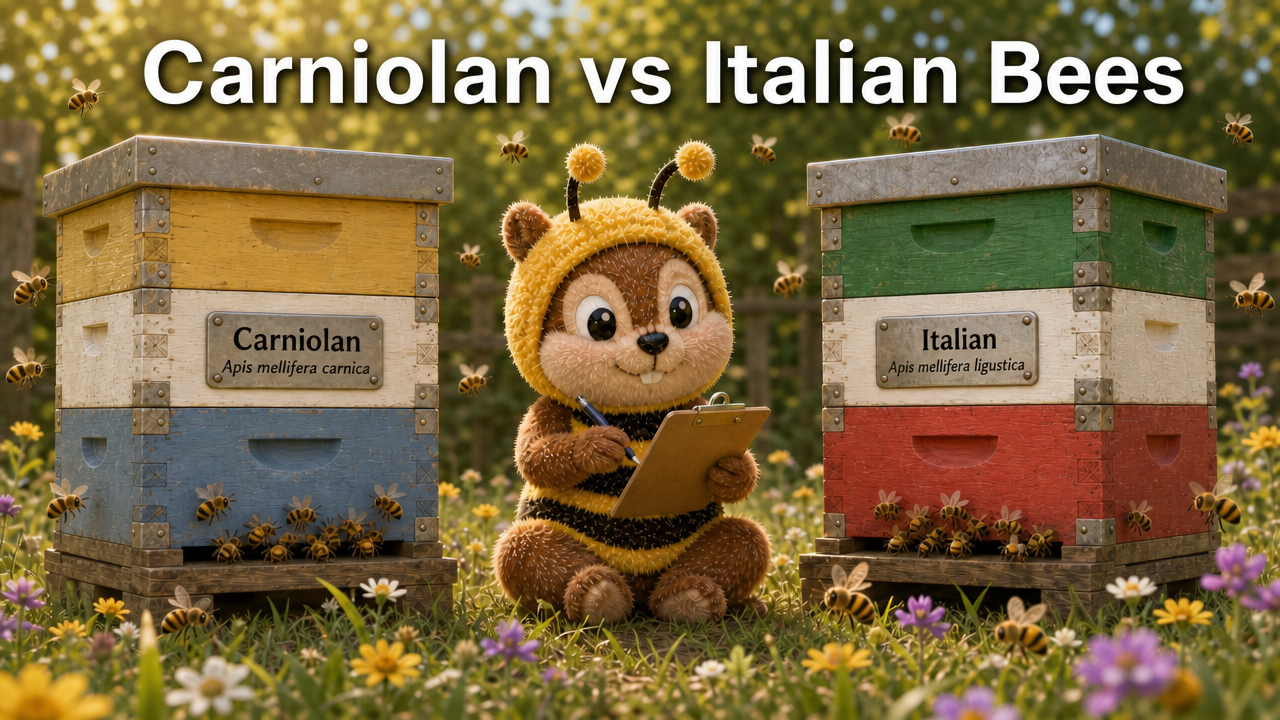
What Makes These Two Subspecies Different
Italian bees (Apis mellifera ligustica) evolved on the Italian peninsula, where the climate is mild and nectar flows last a long time. That shaped a bee that keeps rearing brood well into autumn, maintains a large workforce through summer, and doesn't react dramatically to short-term changes in forage availability.
Carniolan bees (Apis mellifera carnica) came from the Alpine and Danubian regions of central Europe, where winters are harsh and springs can be short. They evolved to shut down fast in autumn, winter in a small cluster, and then explode in population the moment spring pollen starts flowing. That agility is their defining trait.
Appearance
The visual difference is real and useful in the apiary. Italian workers have yellowish to golden-brown abdominal banding. The queen is noticeably lighter than the workers, which makes her easier to spot during inspections. This is mostly a minor convenience, though educators running hive demonstrations sometimes find it a practical plus when they need to find the queen quickly in front of a group. For most beekeepers, queen visibility is a low-priority factor compared to everything else covered below.
Carniolan workers are darker, often described as grey-brown or nearly black, with a softer greyish hair covering. Their queens are harder to spot against the mass of darker workers.
Propolis Use
Carniolans use very little propolis, which keeps frames cleaner and easier to pull. Italians use a moderate amount. Neither is extreme compared to high-propolis stocks like the Caucasian bee, but it's worth knowing if you inspect frequently.
Brood Cycle and Seasonal Rhythm
This is the most important practical difference between the two.
Italian brood cycle: The queen ramps up in spring and largely stays at high output through summer and into early autumn. The colony maintains a large, steady workforce. During a nectar dearth, Italians will often keep rearing brood anyway, drawing down stores to do it. This is the main management risk: colonies that don't adjust to forage conditions can eat themselves out of winter reserves if you're not paying attention.
Carniolan brood cycle: The colony is tightly coupled to what's happening outside the hive. When pollen hits in spring, the queen ramps up fast, often faster than Italian colonies. When forage drops, she scales back. In autumn, brood production drops sharply and the colony heads into winter smaller. That frugality is the Carniolan's biggest practical advantage in northern climates.
The consequence of the Carniolan spring surge is a management challenge: swarming. A colony that grows fast in a restricted space will throw a swarm. Carniolan beekeepers who aren't watching closely can lose the spring buildup to a swarm cast before the main flow even starts.
Temperament
Both are considered gentle stocks in modern beekeeping literature, and in practice both are very manageable. Some nuances worth knowing:
Carniolans are frequently described as the calmer of the two, sitting still on frames with minimal smoke required. This makes them appealing for backyard beekeepers with close neighbours, or anyone who wants lower-stress inspections.
Italians are calm too, but some strains will run on comb if smoke application isn't steady. Neither stock should be confused with defensive Africanized genetics.
Large variation exists within each subspecies depending on the queen's breeder and local conditions.
Robbing and Drifting
This is one of the most consistent real-world differences and it matters operationally.
Italian bees are more prone to robbing weaker hives and have a weaker sense of orientation, which leads to higher rates of drifting (workers entering the wrong hive). In a tight apiary, drifting is a meaningful vector for spreading Varroa mites and pathogens between colonies.
Carniolan bees orient more precisely and are much less likely to rob. This makes them a better fit for high-density apiaries, community bee yards, and situations where you want each colony to stay self-contained.
Honey Production
There's no universal answer on which one produces more honey. Productivity is shaped by forage type, climate, and management far more than subspecies label, and anyone who gives you a simple ranking is leaving out most of the picture.
What the two stocks do differently is respond to the shape of the nectar season. Italians maintain a large, steady workforce through summer, which suits them to long, sustained flows where colony size is an advantage over an extended period. Carniolans reach peak population faster in spring, which suits them to short or early flows where the timing of the foraging force matters more than its size in July.
In practice, a beekeeper in a climate with a prolonged summer flow may find Italians more productive. A beekeeper with a short spring window that's done by mid-summer may find Carniolans better positioned. But neither stock will reliably outperform the other across all conditions, and management quality will likely vary the outcome more than the subspecies choice.
Overwintering
This is where Carniolans have the clearest edge in cold climates.
Carniolan colonies winter in a smaller, tighter cluster. They shut down brood production in autumn, which means they go into winter with less overhead and consume stores more slowly. In northern regions with long winters, this frugality is a genuine economic advantage: you're not feeding as much supplemental syrup, and the colony arrives at spring in better shape.
Italian colonies maintain a larger cluster through winter, partly because they continue rearing brood later into autumn. More bees means more heat to maintain and more stores consumed. Late winter starvation is a real risk with Italians in cold climates if reserves weren't built up adequately going in.
One catch with Carniolans in early spring: they're so sensitive to pollen availability that they may start building aggressively in February or March during a mild stretch, only to face a late cold snap that burns through the remaining stores. Monitor closely during the transition months if you're keeping Carniolans.
Varroa and Disease
Neither Italian nor Carniolan bees are reliably Varroa-resistant. Both are conventional commercial stocks that require active mite monitoring and treatment. Don't choose a stock based on resistance claims unless you're specifically sourcing VSH (Varroa Sensitive Hygiene), Pol-Line, or another purpose-selected resistant line.
That said, there are differences worth knowing:
The Carniolan tendency to halt brood production in autumn creates a natural brood break. Varroa mites need capped brood cells to reproduce, so interruptions in the brood cycle slow mite population growth. This is a management-relevant trait, not resistance, but it can reduce mite pressure heading into winter.
On disease more broadly, Italians are noted for good resistance to European Foulbrood and strong hygienic housekeeping. Carniolans are generally considered good resistors to brood diseases and historically showed better tolerance to tracheal mites. Neither stock should be assumed disease-proof.
For Varroa specifically, your monitoring frequency, treatment timing, and queen quality matter far more than which subspecies you chose.
Which Bee Fits Your Situation
| Situation | Carniolan | Italian |
|---|---|---|
| Long cold winters, frugal stores needed | ✓ | |
| Long warm season with sustained forage | ✓ | |
| Short or intense early spring flow | ✓ | |
| Beekeeper who prefers flexible inspection schedule | ✓ | |
| High-density apiary, robbing a concern | ✓ | |
| Easy queen spotting a priority | ✓ | |
| Willing to manage aggressive spring swarm pressure | ✓ | |
| Beginner in a mild climate | ✓ | |
| Cold temperate beekeeper comfortable with active spring management | ✓ |
Managing the Main Drawbacks of Each
Managing Italian colonies:
- Watch stores heading into winter, especially if autumn was long and brood rearing ran late. Weigh or heft hives in September or October.
- Monitor for robbing when manipulating hives or feeding in an apiary with multiple colonies.
- In a dearth, supplement if stores are getting low rather than waiting to see how it goes.
Managing Carniolan colonies:
- Get ahead of swarming. Add supers before the colony feels crowded, not after. Look for queen cells starting in early spring.
- Consider splits as a swarm-prevention tool once the colony starts building fast.
- Check stores in early spring during warm spells that trigger early brood rearing. A late cold snap after an early buildup is the classic Carniolan spring hazard.
A Note on Local Adaptation and Hybrids
In Canada and northern US regions, domestically raised queens adapted to local conditions often outperform imported stock, regardless of subspecies label. A Carniolan or Carniolan-hybrid queen raised in Saskatchewan will know that climate in a way a package shipped from Hawaii does not.
Locally bred hybrids like the Saskatraz, developed specifically for Canadian conditions, blend Italian productivity with Carniolan winter hardiness and Varroa tolerance. If you're in a northern climate and struggling with both winter losses and swarm pressure, a purpose-bred local hybrid may outperform a "pure" imported stock of either subspecies.
The Practical Summary
Carniolans are the right call when your winters are long, your springs are short, and you're willing to stay on top of spring inspections and swarm prevention. They're frugal, gentle, and well adapted to variable climates.
Italians are the right call when your season is long and warm, you want lower swarm pressure to deal with, and a larger sustained workforce through summer fits your management approach.
If you're keeping both, tracking each colony's buildup speed, honey stores, and swarming tendency over a few seasons gives you real data on what performs in your specific yard. That kind of observation, recorded consistently, is often more useful than any general guide.
Frequently Asked Questions
Are Carniolan bees better for beginners?
It depends on your climate. In cold climates, Carniolans overwinter better and require less supplemental feeding, which simplifies one major task. But their strong swarming tendency adds a management challenge that beginners sometimes underestimate. In mild climates, Italians are often more forgiving overall.
Do Italian bees produce more honey than Carniolan bees?
Not universally. Italians often have an advantage in long, steady summer flows because of their larger sustained workforce. Carniolans can match or exceed Italians in short early flows because of their faster spring buildup. The flow type in your region matters more than the subspecies name.
Are Carniolan bees gentler than Italian bees?
Generally yes, Carniolans are described as calmer on the frames with less smoke required. Both are well within the range of manageable, gentle stocks. Within-stock variation from one breeder to another can be larger than the average difference between the two subspecies.
Which bee is better for Varroa resistance?
Neither. Both Italian and Carniolan commercial stocks are mite-susceptible and require active monitoring and treatment. If Varroa resistance is your primary goal, look for specifically selected VSH, Pol-Line, or Russian honeybee stocks rather than relying on subspecies label.
Can I keep Italian and Carniolan bees in the same apiary?
Yes. Many beekeepers run both side by side. Keep in mind that Italian colonies are more prone to drifting, which can spread mites between hives. Use entrance positioning, distinctive hive colours, or landmarks to help orient foragers to the correct box.

Track each colony's buildup speed, honey stores, and swarm pressure over multiple seasons with Hivemunk's inspection log. Patterns you record now make better stock decisions next spring.
Commitment to Accuracy: If you find any errors or inaccuracies in this guide, please report them using the chat feature. I appreciate your help in maintaining high-quality content.